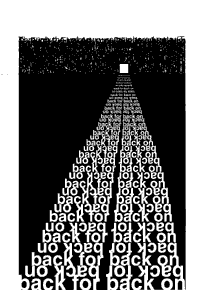
"Our mission is to continue the oral tradition utilizing modern technology."


"I believe there is simply ourselves, and where we are has a particularity which we'd better use because that's about all we've got...there is no other culture. There is simply the literal essence and exactitude of your own. I mean, the streets you live on, or the clothes you wear, or the colour of you hair....Truth lies solely in what you do with it....
Put an end to nation, put an end to culture, put an end to divisions of all sorts."

“observing progressive scholarship and supporting adventurous book making in the context of exploring the relationships between seeing and reading, reading and seeking.”
"The physical fact of language --uttered, inscribed, marked, or frozen in front of our faces in the cold light of bitter days -- reminds us that there is no communication without the phatic exchange of substances.
A prophylactic attitude attempts to protect the imagination from direct encounters with the world as the tongue, the hand, the arm, the fist around the pen, the fingers on the keyboard all reach into the heavy flesh of matter and are rewarded by the sensate experience."
"Bell Labs scientist Thomas K. Landauer (pictured above) determined in 1984 that human beings can retain about 2 bits of memory per second. This holds under all experimental conditions whether the information is visual, verbal, musical, etc."via Accelerating Future who mention the intriguing
"Maybe I will be the last person on Earth to get an e-mail account, but that won't be a bad thing. "Evelyn Lau

The Scalable City is a set of projects that explore the externalization of algorithmic approaches to urbanization which intersect with geographic, political, economic and aesthetic zones of conflict.

"This paper examines competing visions for the future of the book in the digital environment, with particular attention to questions about the social implications of controls over intellectual property, such as continuity of cultural memory"Clifford Lynch, First Monday, volume 6, number 6 (June 2001)
"I weep over my imperfect pages, but if future generations read them, they will be more touched by my weeping than by any perfection I might have achieved, since perfection would have kept me from weeping and, therefore, from writing. The saint weeps, and is human. God is silent. That is why we can love the saint but not God."Pessoa, F. (1991). The Book of Disquiet. New York: Pantheon Books.
"Between sleeping and waking
in concrete made flesh
an early ear hears light approach
an early throat groans"
"A death of someone is actually nothing more than what the death causes to leave behind, to bring into view.* Emmett Williams—one of the more famous of the concrete poets, a Fluxist, and simply an otherstream artist of our time—died in Berlin this Wednesday [Feb 14,2007], on Valentine’s Day...."



"Oligodendrocytes are glial cells which form the myelin sheaths around axons in the central nervous system. These cells have a small number of cytoplasmic processes - the name oligodendrocyte comes from the Greek roots oligo, meaning ‘few’, dendro meaning ‘branch’, and kytos which denotes ‘cell’ -...."
"...disruption of the right, but not the left, dorsolateral prefrontal cortex (DLPFC) by low-frequency repetitive transcranial magnetic stimulation substantially reduces subjects' willingness to reject their partners' intentionally unfair offers, which suggests that subjects are less able to resist the economic temptation to accept these offers. Importantly, however, subjects still judge such offers as very unfair..."
Disrupting the Right Prefrontal Cortex
Daria Knoch et al
published online 4 October 2006
[DOI: 10.1126/science.1129156]
"...literature is too multi-faceted, rambunctious, and iconoclastic to fit the limits of any definition... Literary theory does continue to be a central part of the practice of many postlanguage poets, yet they tend to undertake it with an ambivalent and often wearied eye....Thus, while narrative, lyric, spirituality, and a poetics of the everyday appear often as elements that language poets think should be rejected, postlanguage poets such as Juliana Spahr, Susan Smith Nash, Jefferson Hansen, Liz Willis, Peter Gizzi, Chris Stroffolino, Jennifer Moxley, Joe Ross, Lisa Jarnot, myself and many others have been consciously using one or several of these elements in their work, without returning to the sort of naive justifications of those elements that continue to be a feature of more mainstream American poetry."

"...a visual represention of a text—the entire text (twice!) on a single page. A funny combination of an index, concordance, and summary; it uses the viewer's eye to help uncover meaning."
"Doctors take nerves that used to go to the arm and move those nerves onto chest muscles. The nerves grow into the chest muscles, so when the patient thinks “close hand,” a portion of his chest muscle contracts and electrodes that detect this muscle activity tell the computerized arm when to close the hand."
unfinish! investigates artistic processes that are open to change and reversal of decisions.
unfinish! is the battle cry and the curse of digital work that knows no conclusion, but only consecutive versions. A paradigm of digital culture?
Are you ready to unfinish your world?
An ear has been surgically constructed on his arm. The intention with this soft prosthesis is to wirelessly connect it to the internet to enable it to become a listening device for remote others. Stelarc considers the ear prosthesis not as a sign of physical malfunction, but rather as a symbol for an additional feature - not a sign of loss but rather a symptom of excess. Thus he tries to amplify the forms and functions of the human body, exposing its obsolescence and producing a human-machine-hybrid which questions the notion of the architecture, engineering and operation of the human body.